


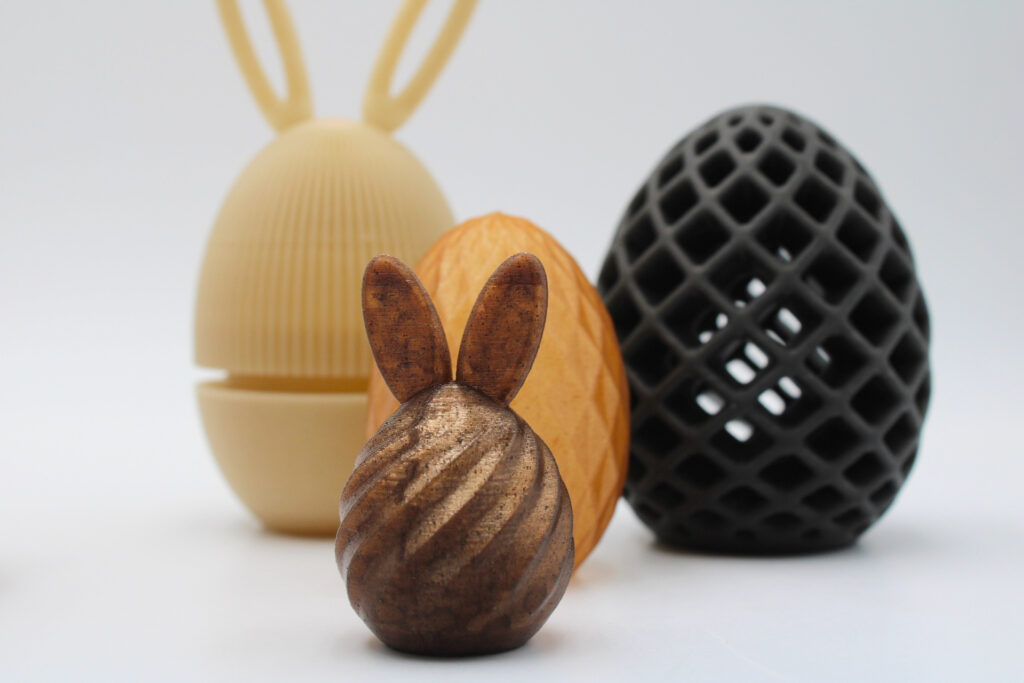
For Easter, NaturePlast conducted a series of trials with 3D printing, using both a creative and technical approach.
The aim is to take advantage of this period to design seasonal objects – eggs, rabbits and other shapes – while exploring the possibilities offered by bioplastics.
Printed objects… enriched with by-products
The parts were made from PLA, a biobased polymer commonly used in 3D printing. To this matrix were added various by-products from natural or industrial resources, such as :
- The scallop
- Coffee grounds
- Brewers’ grains
- Or the brick
These materials, often considered as waste, can be recycled and incorporated directly into bioplastics formulations.
Test, observe and understand
Beyond the visual and seasonal aspects, these trials are part of an experimental approach. In particular, they enable us to evaluate :
- The aesthetic appeal of biocomposites
- Their behavior during the 3D printing process
- Their potential for integration into real-world applications
Each formulation provides specific characteristics in terms of texture, color and processing behavior.
Rethinking materials right from the design stage
This apparently simple project illustrates the many possibilities offered by bioplastics. By integrating by-products right from the material design stage, it becomes possible to develop innovative solutions.
In this context, 3D printing is a particularly interesting tool for rapidly testing new formulations and paving the way for future industrial developments.